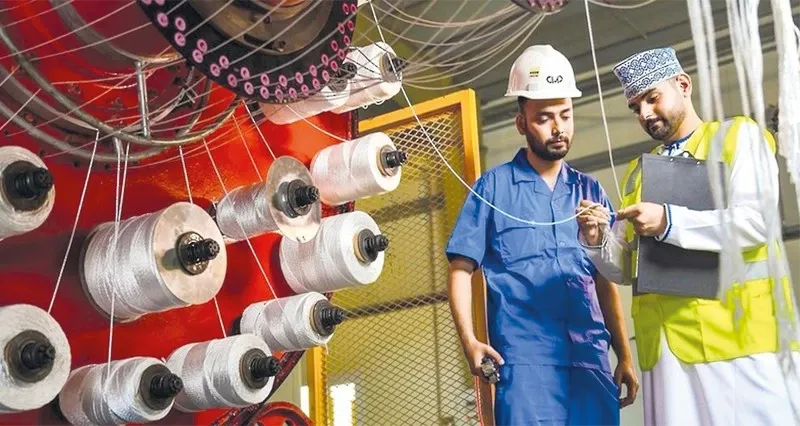
The Ministry of Commerce, Industry, and Investment Promotion recorded positive performance during the implementation of the Tenth Five-Year Plan (2021-2025), achieving a number of significant accomplishments that contributed to accelerating economic diversification and strengthening the role of the industrial and commercial sectors as key pillars of sustainable growth. This was achieved through the adoption of flexible economic policies and the launch of impactful initiatives aimed at improving the business environment, increasing production efficiency, and stimulating investment in value-added activities.
The manufacturing sector emerged as one of the most prominent drivers of growth during the same period, driven by a package of government programs aimed at deepening the production base and enhancing industrial integration, in line with the objectives of the Industrial Strategy 2040.
Data showed that the sector's output rose from approximately 3.019 billion Omani rials in 2021 to nearly 3.710 billion Omani rials in 2025 at constant prices, achieving a cumulative growth rate of about 22 percent and an average annual growth rate of nearly 5 percent. This clearly indicates the growth in production capacity and the improvement in industrial performance efficiency.
Engineer Khalid bin Salim Al-Qasabi, Director General of Industry at the Ministry of Commerce, Industry and Investment Promotion, explained that the government's efforts during the plan focused on building an attractive and stimulating industrial environment by developing infrastructure, simplifying procedures, and providing incentives and facilities for investors, in addition to supporting national industries to enhance their competitiveness in regional and international markets.
He added that the next phase will witness a greater focus on advanced industries with high added value, which will strengthen the Sultanate of Oman's position in global supply chains.
He emphasized that the industrial sector continues to develop its production capacities and enhance its efficiency, focusing on high value-added industries. He noted that the Ministry is working to support national industries to enable them to compete locally, regionally, and globally, thus contributing to strengthening economic sustainability and achieving the goals of Oman Vision 2040.
Regarding the commercial sector, wholesale and retail trade activity recorded moderate growth during the Tenth Five-Year Plan, with its output increasing from OMR 2.744 billion in 2021 to approximately OMR 3.213 billion in 2025, achieving a cumulative growth rate of approximately 17 percent, with an annual growth rate of about 3.4 percent. This stable growth reflects the sector's nature, which is linked to domestic demand and consumption patterns.
Nasra bint Sultan Al Habsi, Director General of Trade at the Ministry of Commerce, Industry and Investment Promotion, affirmed that the sector is witnessing development supported by an improved business environment and increased confidence in local markets. She noted that the Ministry continues its efforts to develop the trade system by enhancing the efficiency of supply chains and expanding the scope of digital transformation in commercial activities, which contributes to improving the quality of services and stimulating consumer activity.
She pointed out that the Ministry is giving special attention to developing the wholesale and retail trade sector, which enhances its efficiency, increases its contribution to the GDP, and reflects the stability of domestic demand and improved consumption levels.
For his part, Engineer Jassim bin Saif Al Jadidi, Technical Director of the Office of the Undersecretary of the Ministry of Commerce, Industry and Investment Promotion for Trade and Industry, said that the growth witnessed in the industrial sector reflects a tangible expansion in economic activities, supported by the adoption of modern technologies, the strengthening of local value chains, and increased productivity levels.
He explained that the Ministry focused on strengthening integration between various sectors, which contributed to supporting the growth of wholesale and retail trade in parallel with industrial expansion. He emphasized that this integration contributes to building a robust economic system capable of facing regional and international challenges. This balanced performance between the industrial and commercial sectors reflects the effectiveness of the adopted economic policies and their ability to achieve efficient integration between production and distribution, thus supporting the path of economic diversification and enhancing the resilience of the national economy in the face of regional and international challenges and changes.
In the coming phase, the Ministry of Commerce, Industry, and Investment Promotion will continue to intensify its efforts to boost non-oil exports by adopting integrated policies that solidify the link between the industrial sector and the export system, thereby contributing to raising the competitiveness of national products in regional and international markets.
In this context, the Ministry also focuses on empowering national industries and guiding them towards exports, improving the efficiency of supply chains, expanding access to foreign markets, and supporting innovation and advanced technologies in production processes, thereby enhancing added value and keeping pace with the requirements of global markets.
It is worth noting that non-oil exports rose during 2025 to approximately 6.7 billion Omani rials, compared to 6.2 billion Omani rials in 2024, registering a growth of 7.5 percent. Re-export activities also achieved remarkable growth of 20.3 percent, reaching 2.056 billion Omani rials, compared to 1.708 billion Omani rials in the previous year.
Products from the chemical and related industries, metals and their products, metal products, plastics, and electrical machinery and equipment topped the list of Oman's most prominent non-oil exports, reflecting the diversification of the production base and its capacity to support export expansion.